Search
Search PnL Blog
Search across every article by title, topic, category, tag, or section. Everything runs in your browser, so results update as you type.

Macro
CPI Trading Checklist: How to Prepare for an Inflation Release
A CPI release can change volatility across stocks, bonds, forex, and crypto. Use this trading checklist to plan exposure, size risk, and avoid reactive decisions.

Tools
Emotional Trading Apps: What to Track Beyond Profit and Loss
An emotional trading app should help you record the plan, feeling, decision, and outcome behind each trade. Here is what to track and how to use it without overcomplicating your journal.

Macro
FOMC Trading Checklist: How to Plan for a Fed Decision Day
Use this FOMC trading checklist to prepare for a Federal Reserve decision, protect risk during fast price moves, and review whether trading the event fits your plan.
Trading Psychology
FOMO Trading Checklist: 7 Questions to Ask Before You Chase a Move
Use this FOMO trading checklist before entering a fast-moving stock, crypto, forex, or futures trade. It turns urgency into a clear decision: trade, wait, or walk away.
Trading Psychology
How to Stop Revenge Trading After a Loss
Revenge trading turns one loss into an urgent attempt to win it back. Learn the warning signs, a practical reset routine, and how to review the pattern without shame.

Trading Basics
How to Use an Economic Calendar for Trading Without Reacting to Every Headline
An economic calendar helps traders prepare for scheduled volatility. Learn how to choose relevant events, plan exposure, and record the effect on your trades.

Trading Journal
Trading Journal for Prop Firm Traders: What to Track During a Challenge
A prop firm trading journal should make risk limits, rule adherence, daily drawdown, and execution mistakes visible before they threaten a funded-account challenge.

Trading Basics
What Is PnL in Trading? Profit and Loss Explained
PnL means profit and loss. Learn how traders calculate realised and unrealised PnL, why percentages matter, and how to use PnL without letting one number drive every decision.

Trading Journal
Best Crypto Trading Journal Apps in 2026: What to Track Beyond P&L
Learn what to look for in a crypto trading journal app, including trade context, position risk, volatility, and emotional decision-making.

Trading Journal
Best Day Trading Journal Apps in 2026: What Active Traders Should Track
Compare the features that matter in a day trading journal app, from fast trade capture and screenshots to risk limits and emotional review.

Trading Journal
Best Futures Trading Journal Apps in 2026: Track Risk, Sessions, and Discipline
A futures trading journal should make contract risk, session behavior, and rule breaks easy to review. Here is what to look for.

Trading Routine
Daily Trading Routine: A Practical Plan Before, During, and After the Market
Build a daily trading routine that supports preparation, risk control, focused execution, and a useful end-of-day review.

Trading Journal
How to Keep a Trading Journal: A Simple System You Will Actually Use
Learn how to keep a trading journal with a simple daily process for planning, capturing, and reviewing trades without turning journaling into a burden.

Trading Journal
Options Trading Journal: What to Track for Better Options Reviews
Build an options trading journal that captures thesis, strategy, strike, expiration, risk, and the decision behind every adjustment.
Trading Psychology
How to Stop FOMO Trading: A Practical Plan for Missed Moves
FOMO trading usually starts before the entry. Use these practical rules to handle missed moves, reduce impulsive entries, and protect your trading plan.
Trading Strategy
How to Test a Trading Strategy Before You Risk More Capital
Learn how to test a trading strategy with clear rules, a representative sample, expectancy, and an honest review of execution before increasing size.

Trade Review
Post-Trade Routine: A 10-Minute Review That Builds Better Trading Habits
Use this simple post-trade routine to capture execution, emotion, and risk decisions before memory edits the story.
Trading Journal
Trading Journal Tags: How to Find Patterns in Your Trade History
The best trading journal tags make it possible to compare setups, market conditions, emotions, and rule breaks without overcomplicating your review.
Risk Management
Trading Risk Management Checklist: 9 Questions Before You Enter
A practical trading risk management checklist covering position size, invalidation, daily loss limits, liquidity, and the emotional state behind the trade.

Risk Management
Daily Loss Limit for Traders: How to Set a Stop Day
A daily loss limit is a pre-committed point where trading stops for the day. Learn how to make it a protective rule instead of a punishment.

Trading Journal
How to Review Trades: A 15-Minute Post-Market Process
A fast trade-review process for finding repeatable execution mistakes without turning every losing trade into a personal failure.

Discipline
How to Stop Overtrading Without Missing Good Setups
Overtrading is usually a process problem, not a lack-of-willpower problem. Use these rules to trade fewer, more deliberate decisions.

Wellbeing
How to Take a Trading Break Without Losing Your Process
A trading break can protect decision quality after stress, burnout, or rule breaking. Here is how to pause deliberately and return with a plan.
Risk Management
Position Sizing for Traders: A Simple Risk-First Method
Learn the position-sizing logic behind a trade: define the invalidation point first, then calculate size from the amount you can afford to risk.
Trading Plan
Pre-Market Trading Checklist: A Calm Start to the Session
A pre-market trading checklist helps you define risk, scenarios, and no-trade conditions before the first fast move of the day.

Risk Management
Risk-Reward Ratio in Trading: What It Tells You
Risk-reward ratio compares a planned loss with a planned gain. Learn how to use it without treating it as a guarantee.

Risk Management
Stop Loss in Trading: A Practical Guide to Planned Exits
A stop loss is a planned invalidation point, not a prediction. Learn how to set exits around the trade idea and risk limit.

Trading Journal
Trading Performance Metrics: 7 Numbers to Review Weekly
The best trading performance metrics show process and risk, not just profit. Here are seven numbers worth reviewing in a journal.

Discipline
Trading After a Big Win: How to Avoid Giving It Back
A large winner can create as many execution problems as a loss. Learn how to protect discipline after a strong trading day.

Discipline
How to Rebuild Trading Confidence After Losses
Trading confidence is not forcing the next trade. It is rebuilding trust in a repeatable process after a losing streak.
Trading Journal
Trading Expectancy Explained: The Metric Behind a Repeatable Edge
Trading expectancy combines win rate, average win, and average loss to show whether a process has positive value over many trades.

Trading Journal
Trading Journal Template: What to Track for Better Reviews
A practical trading journal template with the fields that make trade review useful: setup, risk, execution, emotion, and lesson.

Trading Journal
10 Trading Mistakes Worth Tracking in Your Journal
The trading mistakes that matter most are repeatable. Track these execution errors to turn your journal into a practical improvement tool.
Trading Plan
Trading Plan Template: The Rules to Write Before You Trade
A simple trading plan template covering setups, risk, no-trade conditions, and review rules so decisions are made before pressure arrives.

Tools
The 10 Best Trading and Trading Journal Apps in 2026
A real, no-fluff rundown of the apps traders actually use to place trades, track performance, and figure out why they keep losing money in the same way.

Trading Psychology
10 Trading Psychology Books Worth Actually Reading
Skip the hundred generic 'top trading books' lists. These ten are the ones that actually changed how experienced traders think about their own behavior.
Tools
10 Best Trading Research Tools in 2026
Compare ten of the best trading research tools for charts, scanners, economic data, company filings, news, and trade review so you can build a focused workflow.
Tools
10 Best Trading Risk Management Tools in 2026
The best trading risk management tools help you size positions, set a defined loss, avoid impulsive trades, and review whether your process is working. Here are ten worth using.

Trading Psychology
The Complete Guide to Trading Psychology
Everything that actually matters about why traders lose money on setups that should have worked, and what to do about each specific failure mode.
Trading Psychology
12 Signs You're an Emotional Trader (And What to Do About Each One)
A blunt checklist for spotting emotional trading in your own behavior, with a specific fix for each pattern rather than generic advice to 'stay calm.'

Trading Psychology
7 Trading Psychology Myths That Are Quietly Wrecking Your Account
Some trading advice sounds right and does real damage anyway. Here are seven of the most repeated myths about trading psychology, and what tends to be true instead.

education
Behavioral Finance: Biases, Emotions and Financial Behavior
A clear, practical exploration of behavioral finance, its key biases, and how emotions influence everyday investing decisions.

finance education
Bitcoin ETFs see record investor flight as the cryptocurrency hits lowest levels since 2024
Primary keyword: Bitcoin ETFs record investor flight. Analyzes outflows from U.S. spot bitcoin ETFs and the context behind shrinking levels since 2024.

Finance
Bitcoin hoarder Strategy unveils $2bn buyback as share price tumbles
Analysis of Strategy's $2bn buyback plan and its implications for bitcoin holdings, corporate funding strategies, and investor expectations.

finance
Bitcoin nears the $58,000 floor that has marked every cycle bottom since 2015
Bitcoin approaches a long-standing power-law support near $58,000, signaling a potential accumulation zone but with no immediate catalyst for a bounce.

Macro
Australia's Steady June Unemployment Signals Resilient Job Market
Australia's unemployment rate is expected to hold steady in June, a reading that could shift market bets on the next RBA rate move.

Macro
Euro Advances Ahead of ECB Policy Decision
Analysis of how the euro may move as traders brace for the ECB policy decision, with a focus on EURUSD dynamics and what traders should monitor next.
Trading Psychology
How a Trading Plan Reduces Emotional Decision-Making
A trading plan works less by making you smarter and more by moving decisions out of the moment where emotion has the most influence over them.
Economic Indicators
Fed's Favorite Inflation Tracker Is Getting an Overhaul
Overview of an inflation tracker overhaul and its implications for traders and investors, focusing on understanding what changes mean for market readings and decision making.
Commodities
WTI Oil Climbs Above $87 as Middle East Tensions Threaten Key Chokepoints
WTI crude climbed past $87 as escalating Middle East tensions raised the risk of disruption to key oil transport chokepoints.
Behavioral Research
Why Traders Underestimate How Often They Break Their Own Rules
Ask a trader how often they follow their rules and most describe a much more disciplined pattern than their actual trade records show. The gap itself is worth understanding.
Prop Trading
The Psychology of Trading a Funded Account
Trading someone else's capital under a set of rules changes the psychology of every decision, even when the strategy is identical to trading your own account.
Commodities
Oil Prices Slip as Traders Weigh Mixed Supply Signals
Crude drifted lower this week as traders parsed conflicting signals on production, inventories, and demand heading into the back half of the year.
Trading Mindset
Trading Burnout: Signs You Need to Step Away From the Screen
Burnout does not always look like exhaustion. In trading it often looks like forcing trades, checking price constantly, and losing the patience a strategy actually requires.

Behavioral Research
The Behavioral Gap Between Demo Trading and Live Trading
Many traders perform noticeably differently on a demo account than on a live one, even with the same strategy. The gap is behavioral, not technical.
Behavioral Research
Patterns in Retail Trader Behavior After a Losing Streak
How does position sizing and trade frequency typically shift after a string of losses? A look at the behavioral pattern, with an illustrative example of how it tends to show up.

Behavioral Finance
The Sunk Cost Fallacy and Why Traders Hold Losers Too Long
The money already lost on a trade is gone regardless of what happens next, but it still shapes decisions it should have no effect on. Here is how that plays out.
Discipline
How to Recover From a Trading Slump
A slump usually is not one bad decision, it is a string of small ones compounding. Getting out of it starts with reducing size, not searching for a new strategy.
Risk Management
How Leverage Really Works (and Where It Breaks Down)
Leverage magnifies both gains and losses, but the mechanics of margin, maintenance requirements, and forced liquidation are where most traders get surprised.

Trading Mindset
Is Trading Gambling? How to Tell the Difference
Trading and gambling can look identical from the outside. The real difference is not the activity itself, it is whether there is a repeatable edge and controlled risk behind it.
Trading Resources
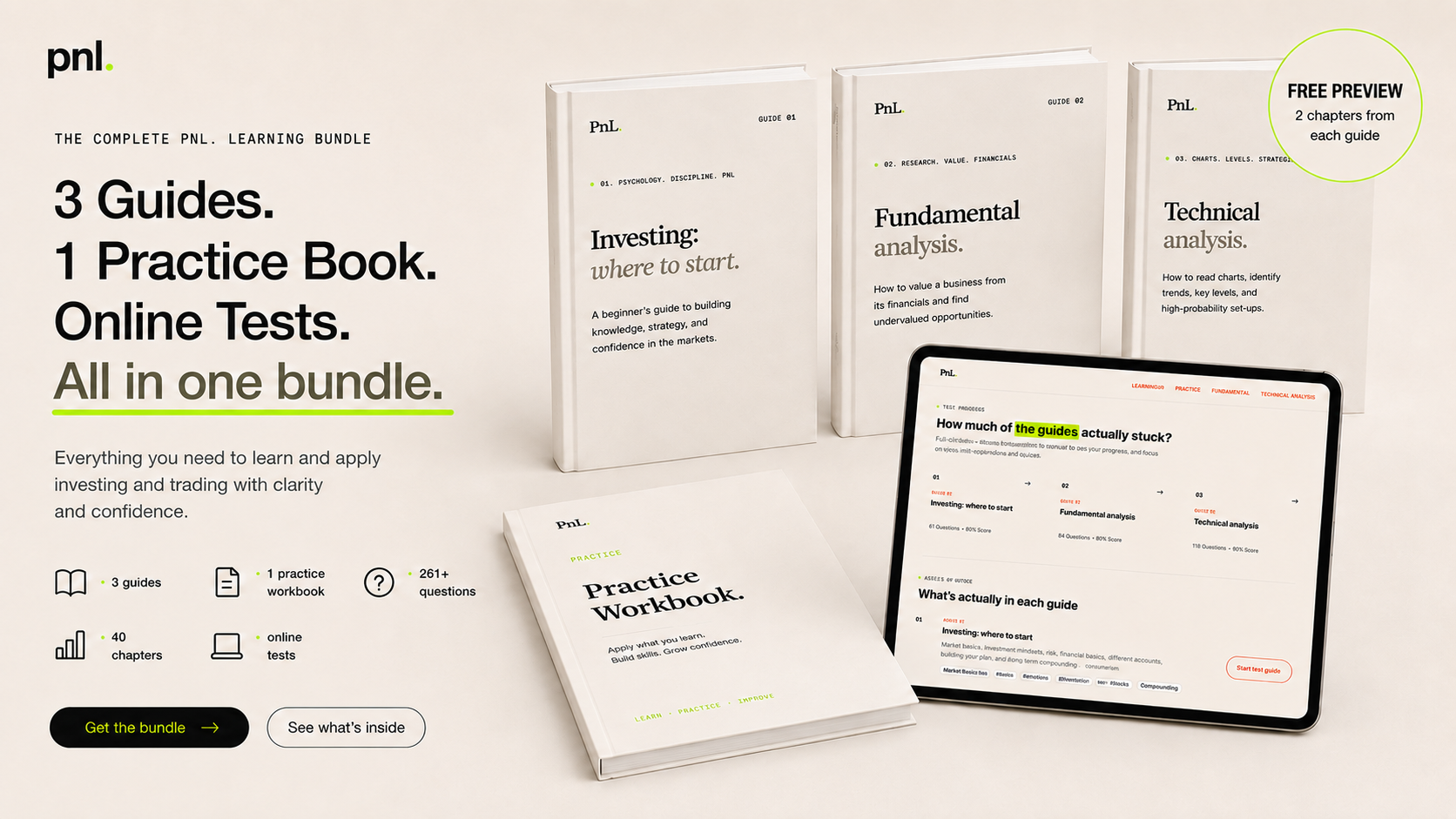
PnL App Trading Guides, Free Preview, and Practice Tests
PnL App's trading education bundle includes a free chapter preview, three full guides, and a practice workbook designed to make learning to trade more structured and practical.
Emotional Trading
Fear and Greed: The Two Emotions That Drive Every Trade
Fear and greed do not just show up around headline market extremes, they shape entries, exits, and position sizing in every single trade.
Discipline
Why You Keep Breaking Your Own Trading Rules
Almost every trader has a rule they know is right and still break. The reason is rarely a lack of knowledge, it is what happens under pressure.
Discipline
Revenge Trading: Why the Next Trade Feels Urgent
After a painful loss, the urge to immediately win it back is one of the most predictable and most costly patterns in trading psychology.
Emotional Trading
How to Control Your Emotions While Trading
You cannot delete emotion from trading, but you can build a process that keeps it from making your decisions. Here is what that actually looks like.
Discipline
What Is Trading Discipline?
Trading discipline is following your own rules on the trades where it is hardest to, not just on the easy ones. It is a behavior you can measure, not just a personality trait.
Risk Management
What Is Drawdown?
Drawdown measures the decline from a portfolio's peak value to its lowest point before a new peak is reached, and it is one of the clearest ways to judge risk.
Decision Making
What Is Analysis Paralysis?
Analysis paralysis is overanalyzing a trade to the point of missing the entry entirely. More indicators and more confirmation do not always mean a better decision.
Behavioral Finance
What Is Confirmation Bias in Trading?
Confirmation bias is the tendency to notice information that supports a trade you already want to take, while discounting signals that argue against it.
Behavioral Finance
What Is Loss Aversion?
Loss aversion is the tendency to feel a loss more intensely than an equivalent gain. In trading, it is a major reason traders hold losers too long and cut winners too early.

Discipline
What Is Revenge Trading?
Revenge trading is entering a new trade to win back a loss, rather than because a real setup appeared. It is one of the most common ways a small loss becomes a large one.

Emotional Trading
What Is FOMO in Trading? Meaning, Examples and How to Avoid It
Learn what FOMO in trading means, why it leads to chased entries and poor risk decisions, and practical rules that help you avoid impulsive trades.

Discipline
What Is Trading Tilt?
Tilt is the state of trading from frustration or ego instead of a plan, usually right after a loss. Here is how to recognize it before it costs you more.

Self-Awareness
Fix Your Psychology: PnL App Review
A blunt review of the PnL App: a fast, simple trading journal built to expose the behavioral patterns that spreadsheets make too tedious to track.
Discipline
The Market Doesn't Reward Excitement. It Rewards Boring Discipline.
The most profitable traders spend most of their time doing nothing. Here is why boring discipline, not excitement, is what actually protects a trading account.

Trading Journal
The One Tool That Changed How I Trade (It's Not a Strategy)
Backtesting new strategies rarely fixes a losing account. Here is why tracking real trade data with the PnL App exposed the pattern a new indicator never could.

Execution
Strategy Isn't Your Problem (And You Probably Know It)
Most traders already have a strategy that could work. The real breakdown happens in execution, and it only becomes visible once you start tracking your own data.

Data & Statistics
A Surprise History Lesson: The 1% Tax That Sparked a Revolution (and Your PnL)
The colonial tax that helped spark the American Revolution was about 1 percent. The lesson for traders: judge your system over hundreds of trades, not just one.

Accountability
The Trader Who Blamed the Whales (Stop Blaming the Market)
A trader who blamed brokers, algorithms, and market makers for every loss finally used the PnL App to track his own data, and found the real pattern was his own behavior.

Market Structure
When War Starts, the Oil Market Is Already Moving
Markets do not wait for a headline to confirm a war before they move. Here is why oil, gold, and currencies often react to geopolitical expectations first.

Accountability
Why I Started Using the PnL App (And Stopped Blaming the Market)
After years of blaming the market for his losses, one trader started logging every trade in the PnL App and found the same behavioral mistakes repeating on a loop.

Overconfidence
Why Winning Is the Most Dangerous Thing in Trading
The biggest losses often happen right after a big win, not a bad one. Here is why overconfidence after winning is one of the most dangerous moments in trading.

Trading Mistakes
Why You're Losing: The #1 Trading Mistake You're Making
Most losing trades are not caused by a bad strategy. They are caused by never tracking your own behavior. Here is how a trading journal turns guessing into data.

No articles matched your search. Try a different word, or browse the sections from the navigation above.